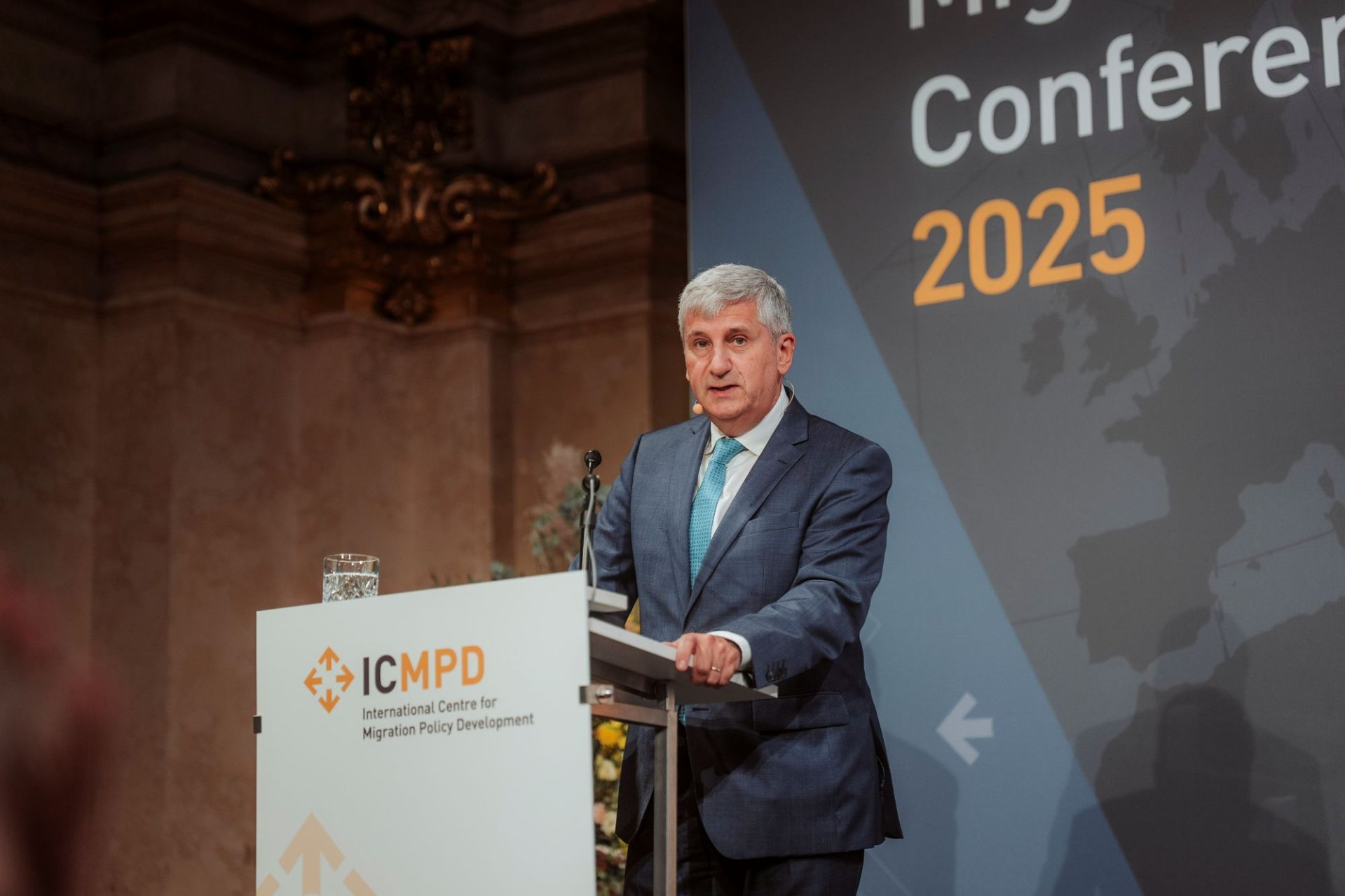
Takeaways from Vienna Migration Conference 2025, ICMPD’s annual flagship event, held 21-22 October 2025.
On the tenth anniversary of the Vienna Migration Conference (VMC2025), leading policymakers, practitioners, and experts in the field of migration convened for two days of focused dialogue. Participants examined recent global and European migration developments and discussed practical, sustainable approaches – ranging from migration partnerships to labour and protection pathways, return and reintegration, ongoing EU reforms, and forecasting migratory trends. Below are six key insights drawn from these discussions.
1. Amidst increasingly transactional politics, values and partnership should be reasserted.
This year’s VMC underscored a widely shared concern: global politics is becoming more competitive, coercive, and transactional. The United States has grown ideologically distant not only from the EU but also from the post-WWII international order. This shift has had wide-ranging consequences, reshaping political priorities across the globe, tightening funding for the UN and other multilateral frameworks, and placing mandates and projects, including those related to migration and humanitarian response, under strain. Meanwhile, other powers are expanding their influence and reorganising alliances to spearhead growth and innovation. Together, these developments are pressuring the EU – both internally and externally – to retreat from its democratic and values-based approach, including the principles that underpin European migration policy.
Yet, within these challenges lies an opportunity for the rules-based order to reaffirm and strengthen itself. Greater cohesion and resolve could support new partnerships and inspire reforms that strengthen global governance, bolster strategic resilience, and promote economic renewal while keeping solidarity, human rights, and the rule of law at the forefront. The Pact for the Mediterranean reflects this ambition of strengthened partnership: by promoting youth talent, entrepreneurship, cultural diversity, sustainable growth, and improved regional migration governance, it seeks to reinforce cooperation between the EU and its Southern Neighbourhood. Across the VMC, there was broad consensus that partnerships remain among the most effective tools for holistically addressing migration challenges. In practice, this means investing in trust and staying responsive to evolving needs.
2. Labour mobility must bring gains for both origin and destination countries.
Labour shortages continue to constrain Europe’s economy and welfare systems, yet many EU Member States struggle to translate labour demand into effective migration solutions. Negative public narratives, obstacles to the recognition of skills and to language acquisition, and weak matching between workers and vacancies all limit progress in attracting talent – even in countries that are more open to migration. Despite the clear economic benefits of labour mobility, highlighted by the European Central Bank, substantial gaps remain. Ensuring Europe’s long-term economic strength will require competitive, predictable pathways for workers across all skill levels (not only the highly-skilled). Key steps include being more responsive to the needs of businesses, strengthening consular capacity, digitalising visa processes, fostering a welcoming environment, and ensuring robust protections for migrant workers throughout the entire migration cycle – whether circular, short-term, or permanent.
Well-designed labour mobility schemes and partnerships can also deliver meaningful benefits for countries of origin, but this hinges upon effective migration governance. The Philippines, one of the world’s largest origin countries of labour migrants, offers several good practices that could serve as inspiration. Its approach to harnessing remittances at both the micro level (supporting livelihood opportunities for workers) and the macro level (through pension and welfare funds, an overseas Filipino bank, and social security programmes that can reinvest funds) provides replicable approaches for other countries of origin.
3. Reintegration deserves more attention as a driver of development.
A notable theme this year was a shift in how reintegration is viewed – not simply as the final stage of a migration journey, but as a potential engine of development for countries of origin. High-level representatives from Egypt, Iraq, Jordan, Mauritania, Moldova, Nigeria, North Macedonia, Pakistan, the Philippines, and Ukraine shared their experiences, highlighting how well-designed reintegration programmes can transform challenges into opportunities.
Ultimately, reintegration is not only about the return of individuals to a specific country; it is also about strengthening the social and economic fabric of countries and regions of origin. Sustainable reintegration requires systematic approaches aligned with national priorities and social cohesion strategies. When embedded in long-term development frameworks, programmes do more than support individual returnees – they also strengthen local economies. In addition to efforts aimed at structural and individual reintegration, participants agreed that greater emphasis should be placed on community aspects: tackling stigma and the social challenges faced by returnees is essential, as community acceptance and family support are pivotal to their ability to rebuild their lives. Returnees often bring back skills, experience, and financial resources, but their potential can only be unlocked if they are welcomed back as assets rather than burdens.
4. It is critical to think ahead about the role of diasporas and returning refugees in Ukraine and Syria’s reconstruction.
The link between reintegration and development is particularly relevant in post-conflict settings, where early planning is essential. As governments begin to consider possible return scenarios for Syria and Ukraine once the respective conflicts come to an end and safety (a precondition for return) is assured, diaspora engagement will be crucial. The situation in Syria remains volatile, and early estimates of reconstruction costs underscore its vast needs. Nonetheless, momentum should be seized to ensure that diaspora actors and returnees contribute to broader recovery efforts and a sustainable peace, addressing not only economic and infrastructure needs but also restoring trust and social cohesion within communities. Since December 2024, around 780.000 Syrians have returned home, mainly from neighbouring countries. In this context, reintegration outcomes will depend on aligning return with long-term development goals so that future returnees are not simply settling back into local communities but are empowered to contribute to their reconstruction and resilience.
Almost seven million people have fled Ukraine amid the ongoing war. The Ukrainian government’s strategy seeks to channel the skills, networks, and financial contributions of its global diaspora into supporting recovery efforts. Initiatives such as Unity Hubs, conceived as cultural, educational, and economic bridges, aim to maintain strong ties with Ukrainians abroad, ensuring they remain engaged in the country’s future and its post-war reconstruction. This approach recognises that reintegration is not solely about physical return but also about fostering a sense of belonging and shared purpose, even for those who may not return immediately, or in the long-term. The energy and resources of diaspora communities represent a vital yet often underused asset for recovery, reconstruction, and development.
5. Shortcomings in the international protection system cannot be solved through asylum policy alone.
The conversations at VMC2025 reflected a broader debate about the evolving meaning – and viability – of international protection. On the one hand, the number of people in need of international protection remains high, with protection systems under severe pressure, exacerbated by funding cuts. On the other hand, protection systems also expend considerable resources processing applications from people without valid protection claims, many of whom apply because of a lack of alternative legal pathways, leaving asylum as their only route to regularising their status. Meanwhile, countries outside Europe continue to host the majority of displaced persons, yet lack sufficient solidarity mechanisms to support them in providing protection and other essential services.
Addressing the challenges posed by mixed human mobility through asylum alone is insufficient; migration systems should function more effectively across the board. EU Member States are currently preparing for the rollout of the Pact on Migration and Asylum, which is meant to create a more consistent and responsive migration governance system. Also needed is the improvement of labour mobility pathways and complementary pathways, as well as effective and fair return procedures for those not found eligible for protection and capacity development for countries along migration routes. Last but not least, if designed with strong safeguards and fundamental rights at their core, forecasting tools offer potential to help policymakers better anticipate arrivals and proactively devise mid- to long-term sustainable responses such as those related to reception and integration.
6. EU reforms are moving full steam ahead.
Recent EU policy developments on migration, particularly the Pact on Migration and Asylum, mark a pivotal shift toward a more unified and responsive EU migration governance system. As the Pact will enter in force by mid-2026, Member States now focus on practical challenges, like aligning national legislation, upgrading IT and judicial systems, and ensuring adequate staffing to meet the new procedural deadlines. The Pact introduces a permanent solidarity mechanism to support states facing migratory pressures, while also catering for faster asylum processing and stronger border controls. Participants stressed the need for realistic expectations, as the Pact is seen as an evolutionary step rather than a revolutionary fix. The success of its implementation will depend on flexible cooperation, continuous technical support, monitoring and evaluation, as well as a shared commitment to managing migration as a routine governance issue rather than a perpetual crisis.
The proposed Return Regulation and the Pact for the Mediterranean further illustrate the EU’s dual approach to migration management. Both initiatives underscore the EU’s effort to balance efficiency with fundamental rights, while addressing the diverse needs of Member States and partner countries. The key to success lies in pragmatic implementation, adaptive policies, and sustained political will to turn these frameworks into effective, trustworthy systems, combining migration management efficiency with respect for fundamental rights.
To learn more about the Vienna Migration Conference 2025, visit the VMC2025 webpage.
The full VMC2025 programme and all video recordings are available online.