In an increasingly complex global environment, joint responsibility for border governance must integrate security, mobility, sovereignty and adherence to international obligations. At the same time, effectiveness and respect for fundamental rights must go hand in hand in a consistent and credible way. This was the key message of Malin Frankenhaeuser, Director of Policy, Research and Strategy at ICMPD, at a keynote address to this year’s World Border Security Congress on 14-16 April 2026 in Vienna.
National border agencies face an environment of rising tensions, conflict, and cross-border crime. This raises expectations for states to manage the risks and safeguard their borders, while maintaining public confidence, often under significant pressure. What is needed is to ensure effective border management while fully adhering to human rights and international standards.Ms Frankenhaeuser said at the opening panel.
At this year’s Congress, over 400 delegates from 73 countries highlighted the common challenges and showcased innovative approaches and solutions shaping border security across different regions – particularly in light of the current geopolitical situations in Europe and the Middle East. Government officials, experts and practitioners from border agencies, international organisations and industry, shared experiences and ideas in tackling irregular migration, transnational crimes including human trafficking and migrant smuggling, evolving security environment; as well as on the integration of new technologies, interoperability of systems, data exchange mechanisms, and the growing role of AI in border management. These themes were also discussed in the context of aligning with and upholding human rights and international obligations.
Well-managed borders also support functioning asylum systems, enable orderly migration, and contribute to effective return and reintegration. Our work [at ICMPD] focuses on professionalising border management, and supporting integrated approaches that strengthen coordination between institutions, improve the use of data and risk analysis, better clarify roles and responsibilities, support the infrastructure and equipment border agencies need to operate effectively, and integrate fundamental rights in daily operations.Ms Frankenhaeuser added.
Tony Mihaitoaia, Senior Advisor for Border Management and Security, contributed to the plenary session on cooperation between customs and border management authorities, presenting experience from Joint Mobile Teams (JMT) operations in West Africa – one of ICMPD’s regional focus areas. The intervention addressed coordination across agencies and countries, focusing on clear legal and operational responsibilities, cooperation mechanisms, enhanced situational awareness, and joint planning and risk analyses supported by standardised procedures, training and exercises, and structured information and intelligence sharing.
These joint operations bring together key border management authorities, including immigration and border police, customs, police and intelligence services, within a coordinated operational framework, with due consideration of civil society actors. “Effective coordination in this context is essential for translating inter-agency cooperation into practical results, enabling timely responses, more efficient use of resources, wider operational coverage and stronger engagement with border communities. This is particularly important in increasingly complex operational environments, where different agencies must work together across mandates and jurisdictions,” he said.
Along with ICMPD’s Ms Frankenhaeuser and Mr Mihaitoaia, several other panel discussions at the Congress featured representatives from the European Commission, OSCE, UNODC, EUROPOL, INTERPOL, the US Customs and Border Protection, IOM, Frontex, UNHCR, among others; as well as the private sector, and national and regional land, air, and maritime border authorities, police and armed forces, customs and immigration offices, and border and security agencies.

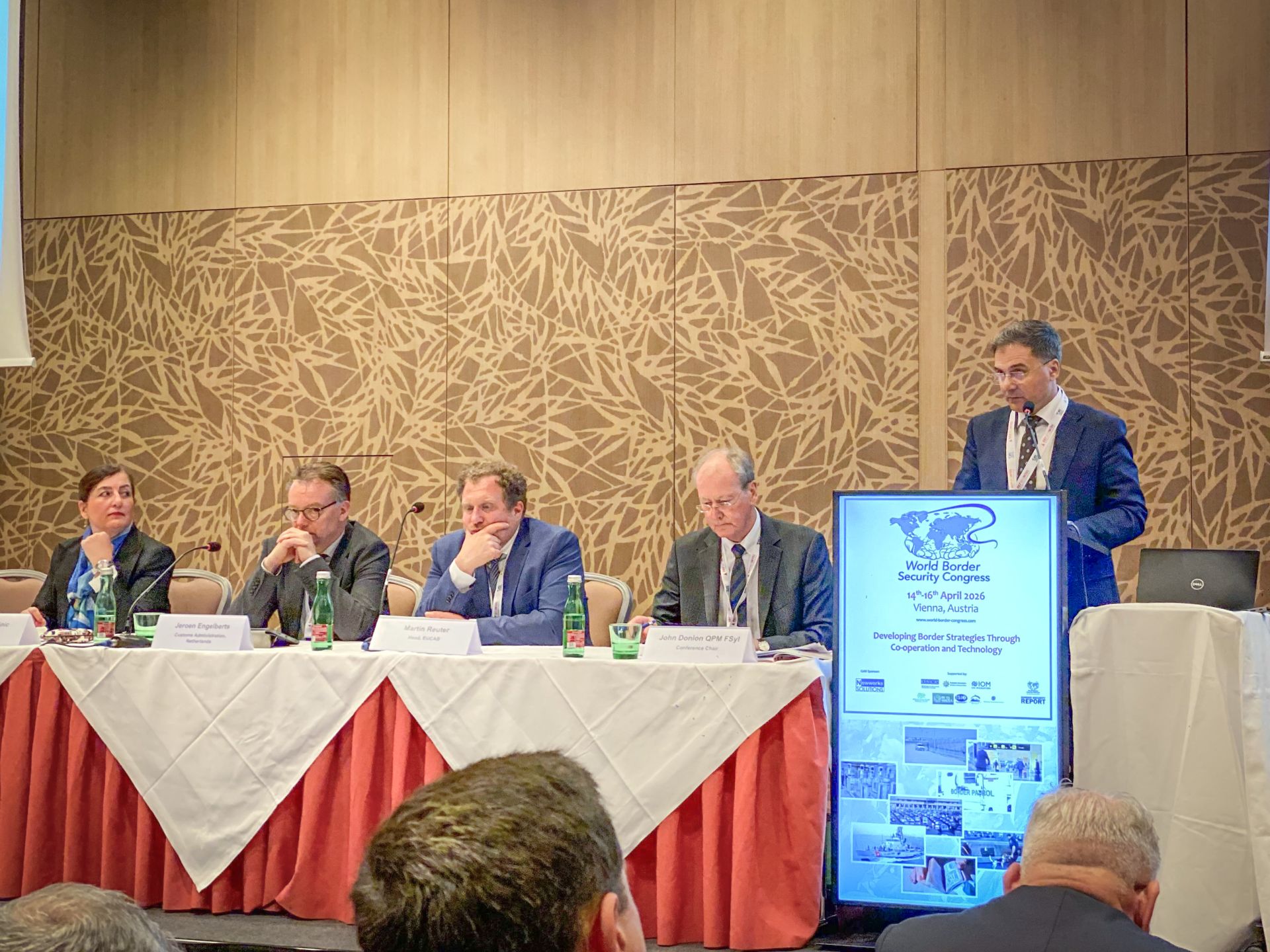
Malin Frankenhaeuser, ICMPD Director of Policy, Research and Strategy, delivering the keynote address at World Border Security Congress 2026