
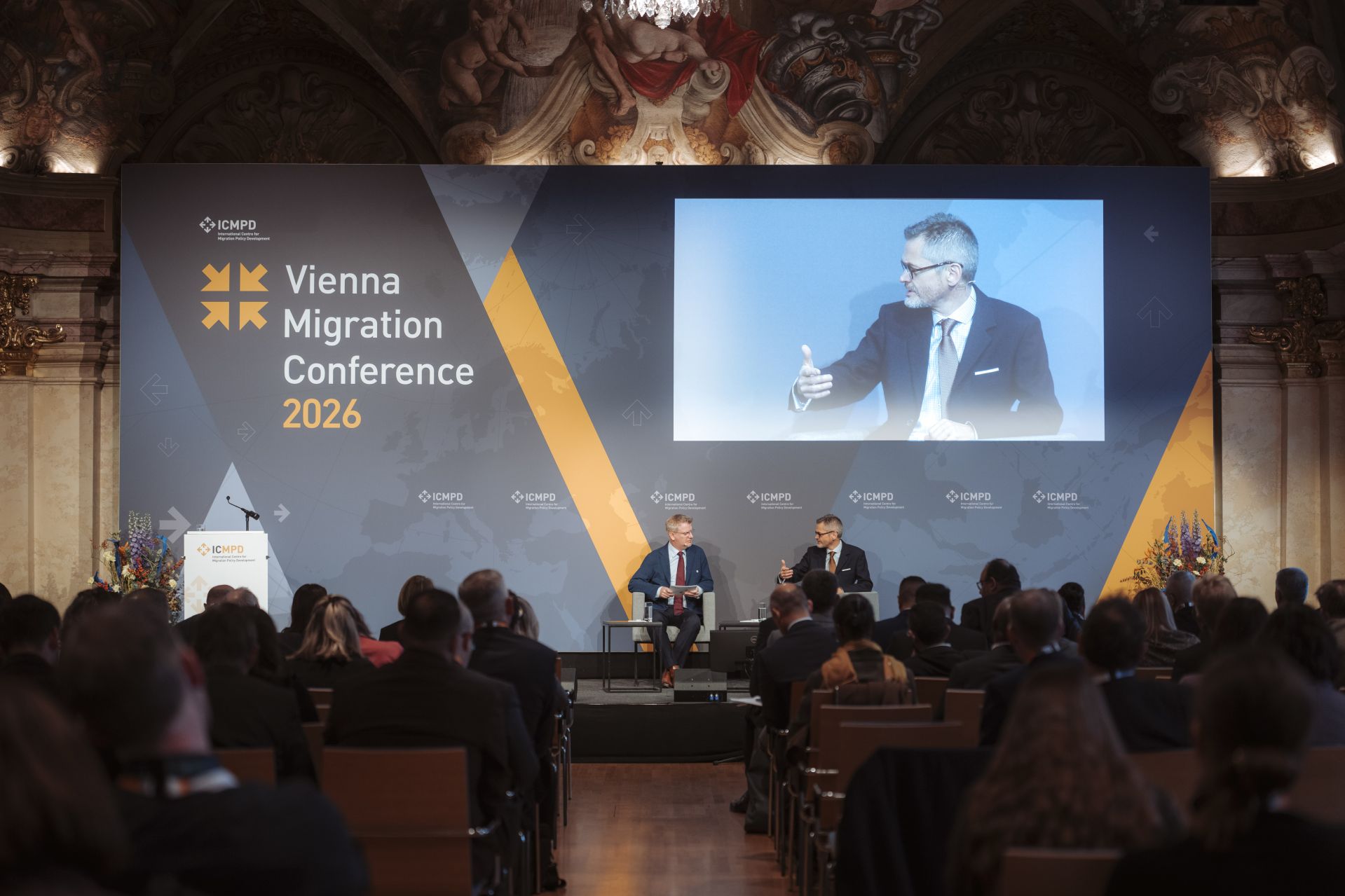
The Vienna Migration Conference 2026 featured two days of wide-ranging discussions on the challenges and opportunities regarding migration and policy. Ministers and senior officials from 18 countries took the stage, alongside representatives from EU agencies and international organisations, to examine migration governance, with discussions focusing on implementation, partnerships, and labour mobility.
Hosted by the International Centre for Migration Policy Development (ICMPD) on 16-17 November 2026, the conference came five months after the EU Pact on Migration and Asylum took effect, and one month after the EU Return Regulation was adopted. Speakers stressed the importance of implementing these new rules, as well as the need for partnerships to expand legal pathways, operationalise whole-of route-responses, and improve responsibility-sharing.
We met at a time of rapid change and mounting challenges, but also of progress and opportunity. It is truly encouraging that policy developments over the past year, as well as the many contributions at VMC 2026, confirmed that the global migration community can find new solutions and make remarkable progress, even when the times are challenging.Susanne Raab, Director General of ICMPD, said
Speaking from Brussels, European Commissioner for Migration and Home Affairs Magnus Brunner said: “This conference really matters because no country can manage migration alone. In a world where many are turning inward, Europe is choosing reliable partnerships that deliver for both sides, preventing irregular departures, fighting smugglers, and improving returns, while supporting investment, supporting people-to-people contacts, and also our partners' capacities.”
Panels, plenaries, and roundtable discussions included ministers and senior officials from EU Member States, as well as Jordan, Armenia, North Macedonia, Norway, Ukraine, Rwanda, India, the United Arab Emirates, Egypt, and Uganda. This year’s Conference gathered over 1,500 participants joining in-person and online, from 61 countries. Over the two days, panellists and delegates exchanged views, lessons, and best practices:
- Geography, geopolitics, and borders: The Executive Directors of Frontex and of the EUAA highlighted that the Pact’s tools are already showing tangible results in strengthening the border asylum systems, but that risks remain. Rather than competing priorities, security and protection are there to reinforce one another, with fundamental rights underpinning all operations.
- Partnership: Particular attention was paid to the newly announced cooperation on Return Hubs as a way of working with partner countries on the issue of returns. The need for shared responsibilities, not shifted responsibilities, was emphasised throughout the conference.
- Ukraine’s human capital: The Deputy Minister of Ukraine’s Ministry of Economy and Environment spoke about the need to respond to the immediate human and economic impact of war while also working to secure the country’s future.
- Labour mobility: Senior officials from India and the United Arab Emirates shared their priorities and ambitions on talent mobility, while the AU’s African Migration Observatory and the OECD shared how changing regional dynamics and global uncertainty are shaping and testing labour markets, and how mobility can be designed with a long-term perspective to bring mutual benefits.
- Integration: Several speakers noted the importance of integrating refugees and other migrants into their societies, to enable them to be self-sufficient, to contribute to the economy, to retain needed workers, and to show the public the positive aspects of migration.
- What is next for EU policy: The Director-General of DG HOME at the European Commission stressed that Europe's capacity to anticipate and respond to emerging migration pressures needs to be strengthened by monitoring developments, particularly in the digital space, anticipating potential crises earlier, and using EU emergency instruments more effectively.
Discussing global changes in labour mobility alongside other panellists, African Migration Observatory Director Namira Negm highlighted the need to expand regular mobility opportunities and strengthen the transferability of skills and qualifications, as well as to harness its development potential while ensuring the protection of migrants' rights. “The benefits of migration will not be fairly distributed on their own – they have to be baked into how migration is governed,” Ms Negm said.
We have finally entered a phase of putting policy into practice. This is what makes the real difference for the Vienna Migration Conference, in terms of delivery and of public acceptance. The events of this year, from the war in the Middle East to the displacement crisis in Sudan and the events at the Ceuta border, have shown us once more that the global migration landscape remains highly volatile, that when working in migration, we always have to prepare for fast and unexpected developments.Director General Raab said
The Vienna Migration Conference 2026 was made possible thanks to the support of the Organisation for Refugee Services (ORS) and the City of Vienna, and additional contributions from the United Nations Office on Drugs and Crime (UNODC), the Inter-Governmental Consultations on Migration, Asylum and Refugees (IGC), and the Robert Bosch Stiftung (RBS).
Note to Editors
A set of quotes from all speakers at the plenaries and armchair discussions can be accessed here. An image gallery is also available.
Recordings of the sessions will soon be available on the VMC website. Takeaways from VMC2026 will be shared in the coming weeks, followed by the full conference report in Spring 2027.
VMC2026 Day 1 - 16 November 2026


VMC2026 Day 2 - 17 November 2026



Photos by Nadine Studeny