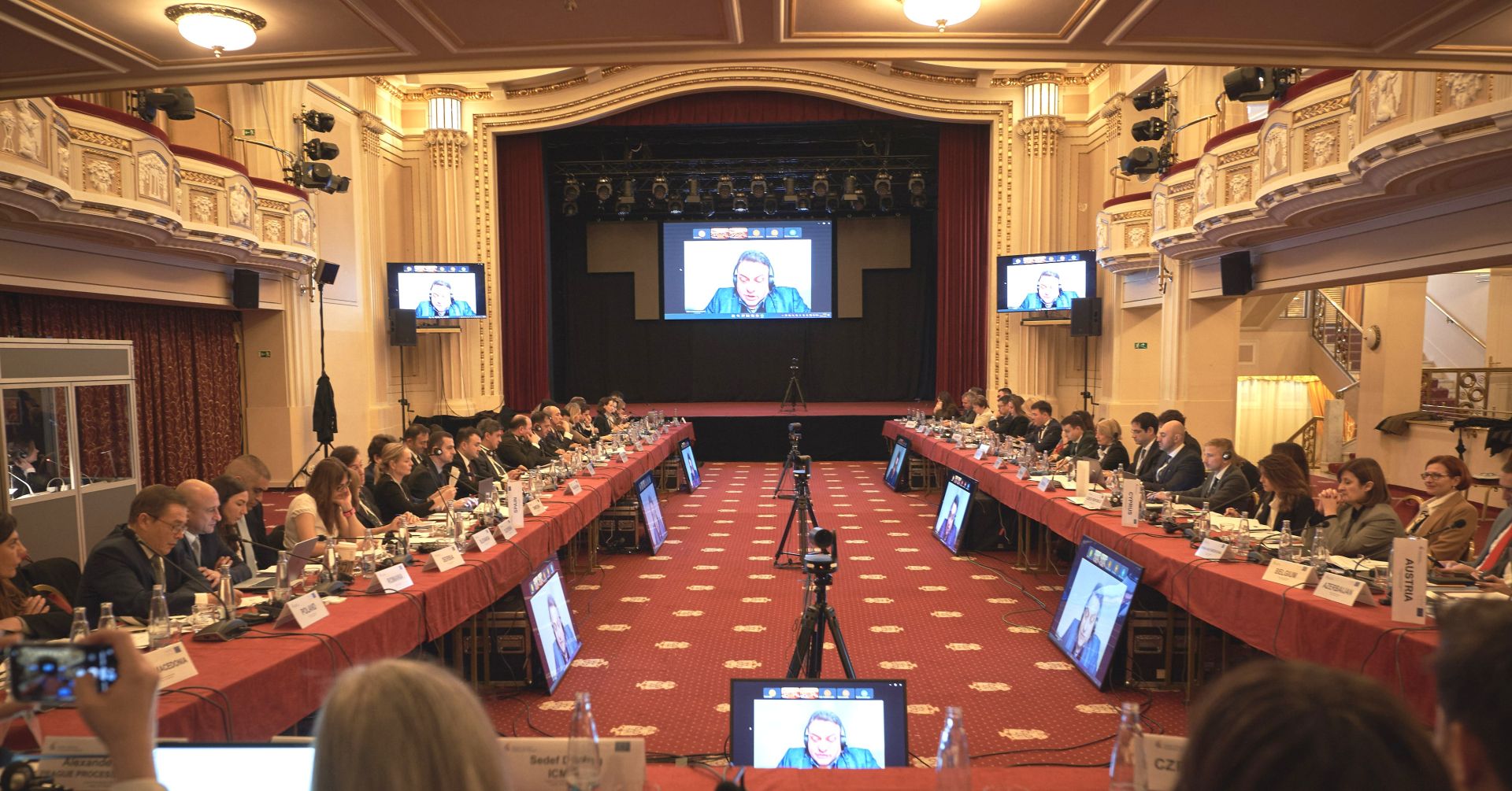
Over 80 representatives of 36 states, the European Commission, EU agencies, and international organisations assessed the results achieved under the four main pillars of work in the Prague Process: Dialogue, the Migration Observatory, the Training Academy and four Thematic Components. At the preparatory meeting on 10-11 November 2026 in Prague, participating states recognised the contributions in improving shared understanding, migration governance, and practical cooperation across the region.
Hosted by the Ministry of the Interior of the Czech Republic, the second preparatory Senior Officials Meeting, ahead of the 5th Prague Process Ministerial Conference provided an important opportunity to take stock of the ongoing Prague Process cooperation and shape its future direction.
In their opening remarks, representatives of the Czech Republic, the Irish Presidency of the Council of the European Union, the European Commission and ICMPD underlined the continued relevance of regional cooperation, strong institutional capacities and partnerships in addressing shared migration challenges.
As migration and international cooperation become increasingly complex, migration dialogues and effective partnerships are more important than ever. Their informal, non-binding character is a strength: it keeps engagement possible where political relations are strained, allowing to adapt to route shifts, broaden participation and respond to crises without renegotiating their frameworks.said Sedef Dearing, ICMPD Deputy Director General and Director for Migration Dialogues and Cooperation.
All this shows how the political agenda itself continues to evolve. Countries of origin and transit are increasingly becoming countries of destination and develop their systems accordingly, creating new areas in which sustained exchange is valuable.Ms Dearing added.
Along with Ms Dearing, participants highlighted the adaptive and demand-driven nature of the Prague Process, including its important contribution to the successful operationalisation of Ukrainian Consultation and Community Centres in several EU Member States, as well as Migrant Resource Centres in Kyrgyzstan, Tajikistan and Uzbekistan. Their services provide tangible support to potential migrants and displaced populations. Further, there was emphasis on the need to strengthen links between political dialogue and practical implementation, leading to tangible results, stronger institutional capacities and practical benefits for national migration governance.
Participants also welcomed the revised draft Action Plan 2028-2032, its streamlined structure, and continued focus on the six established thematic areas. With emphasis on cross-cutting priorities, they called for further strengthening of operational cooperation and regional partnerships on:
- Preventing and fighting irregular migration, migrant smuggling and trafficking in human beings
- Promoting effective and sustainable cooperation on readmission, return and reintegration
- Addressing legal migration and mobility with a special emphasis on labour migration
- Promoting integration of legally residing migrants in their host societies
- Making migration and mobility positive forces for development
- Strengthening capacities in the area of asylum and international protection
Finally, participants welcomed the draft Ministerial Declaration as a comprehensive basis for the future direction of the Prague Process and political commitment; stressing the importance of fundamental rights, protection-sensitive migration management, non-refoulement, preparedness and resilience, as well as responsible use of digital technologies.
The Ministry of Interior of Lithuania, as the incoming Presidency of the Council of the EU, provided an update on the organisational preparations for the upcoming Ministerial Conference in Vilnius.
Senior Officials reaffirmed the importance of the Prague Process as a platform for sustained dialogue and practical cooperation among countries of origin, transit and destination.
Against a backdrop of geopolitical uncertainty, ongoing conflicts, evolving migration patterns and emerging security challenges, they emphasised the need for more coordinated, forward-looking and adaptable policy responses. The meeting concluded with a shared commitment to preserving the strengths of the Process while making its next phase more focused, operational and results oriented.