
Migration links countries of origin, transit and destination in ways that make national policy choices interdependent: decisions taken in one country affect pressures and cooperation needs in others. It also remains politically sensitive at the domestic level, which is why states have been cautious about committing to binding multilateral frameworks. With ensuing geopolitics and conflicts, strained relations among states, aid cuts driving reprioritisation, and shifting migratory routes in(to) Europe and beyond, the case for sustained dialogue has become more pressing.
In The value of Regional Migration Dialogues in times of global change recently published by ICMPD, the role of regional dialogues is explained through the lens of the Budapest Process, Khartoum Process, Prague Process, and Rabat Process. Combined, they link European states with partner countries across the eastern and south-eastern neighbourhoods, Asia, and Africa, forming part of the EU’s external dimension on migration.
The paper explores how the unique state-led, non-binding and informal, and highly adaptive character of Dialogues supports durable cooperation across regions. It highlights how their strategic value lies in a whole-of-route approach: migration dynamics unfold across interconnected routes rather than isolated national spaces, so developments in one part of a route shape the pressures, responses, and cooperation needs elsewhere. In practice this means maintaining networks among counterparts, supporting institutional continuity, developing a shared understanding of migration challenges and priorities, and creating opportunities for technical cooperation.
The Dialogues’ expansion reflects the growing recognition that migration challenges can rarely be addressed effectively by states acting alone. Discussions within the Budapest Process contributed to the development of the Migrant Resource Centres, proposed by Pakistan at a meeting in 2013 and since reaching more than 1.5 million people. In the Prague Process, the Ukrainian Consultation Centres followed discussions on what displacement from Ukraine meant for migration systems. Operationalisation of the Rabat and Khartoum Processes has been reinforced through the wider Migration and Mobility Dialogue Support Programme (MMD), alongside growing work on emerging themes in migration governance.
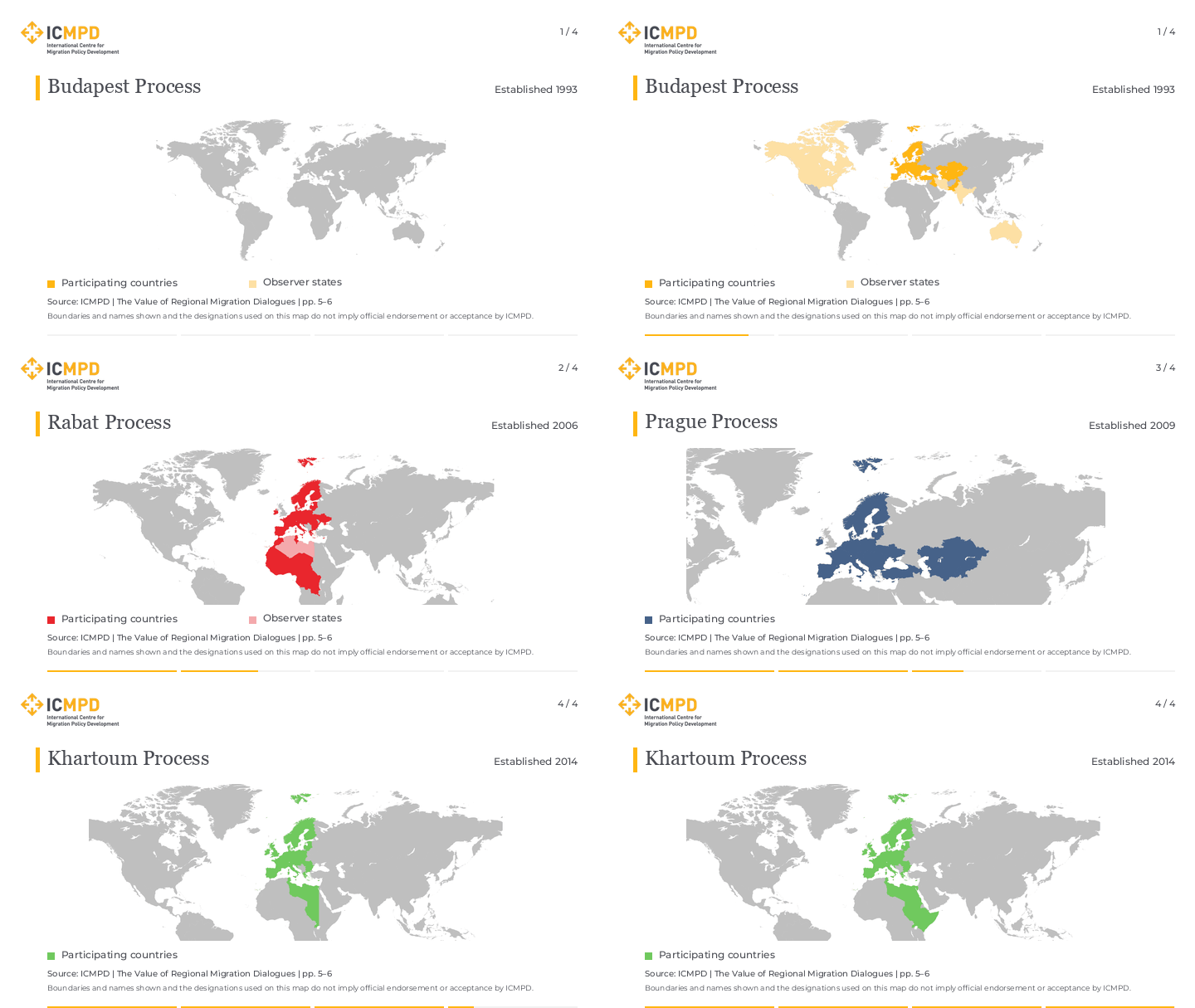
Because all four Secretariats sit within one organisation, ICMPD provides a high degree of continuity, institutional memory and cross-process awareness, allowing coordinators to remain in regular contact on shared challenges, thematic overlaps and working methods. Over time, thematic work has expanded to include temporary protection and asylum, labour migration and mobility pathways, integration, return, readmission and reintegration, and development.
The paper shows how the Dialogues have adapted to evolving migration routes, shifting geopolitics and changing political priorities. That adaptability is what allows them to build relationships, trust and shared understanding, and to respond to emerging issues without losing coherence with their broader frameworks and action plans.