Earlier this year an Eritrean was convicted to serve 20 years in prison for smuggling migrants into the Netherlands, while his accomplice was extradited from the United Arab Emirates to face criminal charges in a Dutch court. Along with co-conspirators, they were charged with inflicting abuse and exploiting migrants in the Mediterranean, before smuggling them across treacherous waters into Europe.
While this is nothing new, it is emblematic how migrant smugglers have long operated with impunity, which Jolanda de Boer and her colleagues across a network of prosecutors and law enforcement are cracking down. Ms de Boer, a public prosecutor of 26 years in the Netherlands, is part of the Joint Team – leading alongside the Center for International Legal Cooperation (CILC) in the IAMROC project under the European Union-funded Migration Partnership Facility of ICMPD. The project tracks serious organised crimes related to migration in countries on the Central Mediterranean Route (CMR) through increased data exchange, and sharing intelligence and investigation techniques.
The January 2026 case that is closely connected to the Joint Team led by Ms de Boer, tells the story of how Eritreans, fleeing dire conditions back home, take long journeys – first on foot, and further up by cars or trucks - across deserts into Ethiopia and Sudan, where they are most likely smuggled. Once they hit a camp across the borders they are “assigned to a smuggler” and taken on another dangerous journey that may take up to two weeks, all the way to North Africa.
Syndicates that smuggle them along the CMR to Libya then force their fellow Eritreans to watch over them and use violence to extort from or film the torture of their own people – all so their relatives abroad pay for their sea crossing into Europe. “Nigerians also go through the same structure: there are [Nigerian] ‘leaders’ assigned in their camps or warehouses, who are forced by smugglers to torture and extort their own people,” Ms de Boer added.
Her work, including with the Europol, involves analysing large amounts of data on the “big players” in migrant smuggling along the CMR where, she says, hundreds of thousands are being smuggled for Europe. The Joint Team has also faced some degree of limitations – including financial resources, complex laws in and coordinating with countries in and outside the EU, a coup in Mali and a civil war in Sudan, and, more importantly, issues of jurisdiction – that hindered their intended successes. Yet amidst all that, by focussing on their high-value targets and where she believed they would succeed in court, they sentenced a major migrant smuggler this year.
People-centred approach – particularly for the survivors
Following the indictment, at least 60 victim-survivors came forward, some of whom applied for reparations from the Dutch courts. They shared their stories, most of the ordeal, often near-death experiences.
Knowing they would be subjected to rape, torture, violence and extortion in the hands of smugglers and their co-conspirators at the borders, did not deter them from going. Women, but also men, know fully well what lies ahead; but they take the risk, or their parents take the chance of sending them anyway.Ms de Boer laments.
Ms de Boer recalls from survivors’ stories that apart from the economic and socio-political hardships at home, many of them left Eritrea for fear of being conscripted into armed conflict. Of those who make it to Europe, including people as young as 12, they would learn that their parents have been conscripted; or that they have been forced to serve in the military for years. Because of that same ordeal, there was also an innate distrust in and fear of the authorities. “It was difficult to gain their trust as well as that of the [Eritrean] community – mostly because of the trauma from what they had gone through on their way to Europe,” Ms de Boer says.
To remedy this distrust, Ms de Boer and her Joint Team colleagues developed a protocol: to contract a fully vetted cultural mediator to facilitate trust-building between the survivors and the authorities; as well as with investigators and court officials. The application process for redress among the survivors also included information provided in their own language. Beyond trust-building, Ms de Boer shared that this protocol enabled the survivors to shift their attitudes about the Dutch legal system, and gave them an overall feeling of safety in Dutch society, including the Eritrean diaspora in the Netherlands.
The stories came flowing: the ordeal, the uncertainty, and the fear. Through careful mediation and the redress, Ms de Boer and her colleagues in the Court – and more broadly the Joint Team – also gathered deep insights into the large-scale migrant smuggling operations that they have been following. More importantly, the stories and the regular interactions gave the Eritrean survivors and their community in the Netherlands a sense of solidarity.
“It was also astonishing to see how important it was for an entire community, whose members fell victims to such horrors, to see their compatriots finding justice,” Ms de Boer recalls from the livestreaming of the sentencing, which was broadcast in Dutch, English, and Tigrinya – watched by an estimated 33,000 Eritreans. “I know what many of them may have gone through, and now they felt seen,” she says.
The CILC echoes this significance for a people-centred approach. In bridging the sometimes abstract concept of justice and rule of law with practical action, CILC’s Georgia Canura says: “Managing projects like this, across multiple legal systems and volatile geopolitical contexts, requires relentless coordination, adaptability, and long-term vision. We are putting the human dimension at the centre of the work with witnesses and survivors; and invest in creating real, human connections that build institutional trust.”
Casting a wider net beyond Europe’s borders
The Joint Team was born out of the shipwreck of 3 October 2013, off Lampedusa – when 368 migrants lost their lives, mostly from Eritrea, Ghana, and Somalia. The response to the trauma, not only to the 155 survivors but also to the Italian law enforcement and rescue workers, yielded the stories of horror of what migrants (have) suffered in the hands of smugglers in Libya.
Many shipwrecks, lives lost, and treacherous crossings followed since, both in the Mediterranean as well as on the English Channel. Ms de Boer recalls a colleague of hers saying, from her previous role at the time, “This is not only an Italian problem nor a [problem] for migrants; this is a shared EU responsibility.”
A year after that Lampedusa tragedy, a member of the Dutch Board of Prosecutors in The Hague – with extensive involvement in cases of human trafficking – liaised with and offered to collaborate with Italy. Following planning and negotiations, years of initial work and a membership that grew, the Joint Team agreement was formally signed in 2018.
If you really want to do something about migrant smuggling and the various schemes that target vulnerable people, you need to look further outside your [EU] borders. What we saw in the Balkan and Eastern European routes, or from Türkiye, is how organised these operations are.Ms de Boer says.
She recalls vulnerable young Dutch people with a driver’s licence were lured into countries like Hungary or Croatia, to come with their car and transport dozens of migrants into the Netherlands – for money. “Certainly they did not come up with the idea themselves; there is a whole organisation behind this,” she notes, having seen reports on this several times over.
But tying up prosecution at this scale, and jurisdiction, is not always easy – particularly when dealing with non-EU countries with very different laws and cultural nuances. The migrant smugglers hauling vulnerable people from Africa, through the Mediterranean routes and into Europe, usually are not in Europe themselves. “So you need to take extra 10 steps to track these criminal groups; how do you identify them, and how can you build a solid case that you know you can win – against the odds of legal and jurisdictional issues,” Ms de Boer stresses.
This is why another component of the IAMROC project provides trainings to law enforcement, judiciary, and public prosecutors in target countries on international legal cooperation, and on investigating and prosecuting financial crimes related to migrant smuggling. In line with ICMPD’s thrust on rights-based approach to migration governance and programming, IAMROC also enhances investigation techniques on migration-related crime syndicates to include human trafficking, torture and killings, sexual and gender-based violence, arbitrary detention, and forced labour along the Central Mediterranean route.
One success at a time, but without letting go
Ms de Boer has witnessed the milestones that judiciaries in countries in Africa have made. “After one of the trainings we provided in Ethiopia, I learned that the country has updated their laws on money laundering – from what they learned from our trainings,” she beams with pride. This was followed by more trainings for federal police on human trafficking and migrant smuggling, which coincided with and led to a fruitful investigation of various domestic cases. This shows clearly a growing demand in migrants and refugees’ countries of origin for accountability. It builds trust in and among institutions.
Nonetheless, alluding to the Joint Team’s birth almost a decade ago, Ms de Boer still gets asked why they cannot prosecute [more] core international crimes, or take on many more cases of migrant smuggling. “It is a matter of jurisdiction. We cannot simply go to a country (outside of the EU) and arrest someone,” she notes. Simply put, navigating a multi-country Joint Team whose justice systems are unique from each other, and running a full investigation of complicated, major international crimes in areas often with equally complicated jurisdictional issues, is no easy feat.
Still, with a clear view of what has been achieved and what the IAMROC partners can do, Ms de Boer is hopeful that the Joint Team or an equivalent thereof can be sustained and taken on a larger scale at the EU-level. She also recalls when they began the work of the Joint Team, that it was clear they could only pursue crimes where they had jurisdiction, sufficient evidence, and the highest chances of a conviction.
At the European level this system will hopefully take shape, through the Europol’s Operational Task Force, but also by taking over other activities of the Joint Team. The way forward, hence, would be to invest in and sustain these efforts to harmonise all partners’ contributions and mandates, and coordinate across complicated investigations and court cases.
Finally, it is vital that Member States, both EU and partner countries outside the bloc, keep this as a priority; along with support from the European Commission. “My dream is that one day, there will be a European Prosecutor’s Office dealing specifically with cases like this,” Ms de Boer says hopefully. The Joint Team’s experience in handling such cases may come in handy.
The January 2026 conviction will not be the last, but Ms de Boer continues to believe that “if we can help each other, share intelligence and build on our systems, it is worth something if criminals are being prosecuted; whether in their own regions or here in the EU.” Because when persons – whose only aim is to find safety and a decent life – are treated inhumanely along their journeys to Europe, that becomes a collective responsibility.
“Succeeding in cases like the Eritrean smuggling conviction, is not achieved overnight; it is delivered through structured and sustained collaboration; and turning complex partnerships into lasting accountability, one solid case at a time,” Ms Canura adds.
Justice can take time, especially the nature of crimes we work with, it can take years – because we want to make sure our case is solid. But we cannot let go, we should not let go.Ms de Boer says.
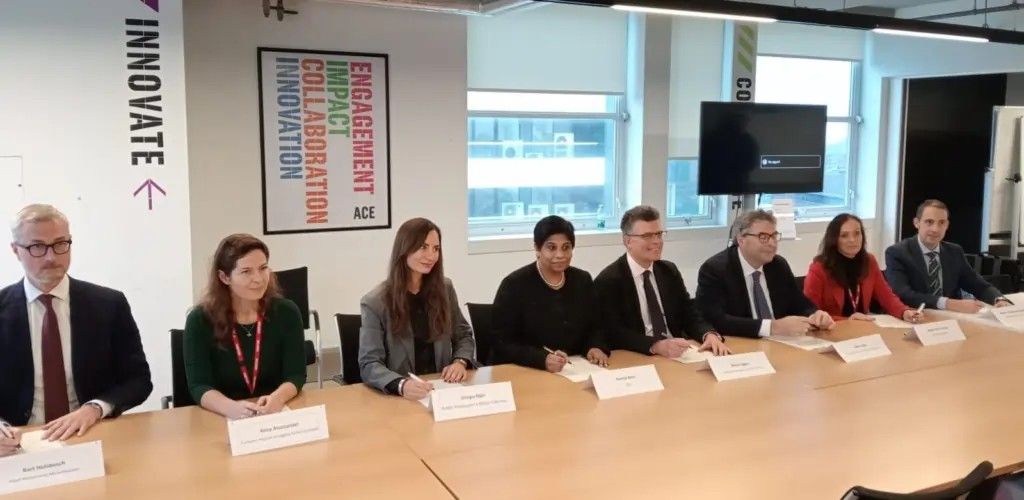

Signatories of the Joint Team Agreement (c) Public Prosecutor's Office (Netherlands)/2024
About the project
The IAMROC project is co-funded by the European Union through the Migration Partnership Facility run by ICMPD; The Hague-based Center for International Legal Cooperation (CILC) and the Dutch National Public Prosecutor’s Office; and cooperates with the Joint Team that includes the Netherlands, Spain, the United Kingdom, Italy, Germany, the International Criminal Court (ICC), and the European Centre Against Migrant Smuggling of Europol.
The contents of this article are the sole responsibility of ICMPD and do not necessarily reflect the views of the European Union.