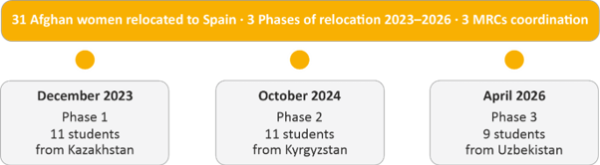
Following the political changes in Afghanistan in 2021, thousands of young Afghan women faced disruptions to their education and uncertainty about their future. Among them were female students who had already begun international scholarship programmes supported by the United Nations Development Programme (UNDP) and the European Union. Continuing their studies in Kazakhstan, Kyrgyzstan and Uzbekistan, they persevered, even as uncertainty about their education and future continued to grow.
By the end of 2023, many had completed their studies, and their temporary stay in host countries was drawing to a close. For many, returning to Afghanistan was no longer a safe option, as restrictions on women's education and employment had deepened.
Against this background, the Migrant Resource Centre of Afghanistan (MRC Afghanistan) arranged group counselling sessions through UNDP in Central Asia. The sessions highlighted the concerns and uncertainty the students were facing as they considered their next steps. While potential resettlement opportunities had been identified, processing timelines created an additional challenge. The MRC in Afghanistan therefore worked through the International Centre for Migration Policy Development (ICMPD) to raise the students' cases through relevant international channels, including engagement with the European Union Agency for Asylum (EUAA).
Following these efforts, Spain agreed to provide educational visas, while the Yaran Foundation committed to support the students' integration into Spanish society and academic life. The relocation involved cooperation between MRC Afghanistan, MRC Kyrgyzstan, MRC Uzbekistan, ICMPD and the Yaran Foundation.
Ahead of the departure, the students received practical preparation for their move, including soft skills training, information sessions on rights and responsibilities, cultural orientation, CV and cover letter support, and introductory Spanish language classes. The support was designed to help them navigate their relocation and prepare for continued education and integration in Spain.
After arriving in Spain, the students continued to receive ongoing support through language courses, integration activities and community assistance.
Many spoke of a sense of freedom and independence they described as currently unavailable to women in Afghanistan — including the ability to study, to work, and to shape their own future.
The students also began participating in activities in their new communities. Just one week after arriving in Spain, a group of five Afghan students who had relocated from Kyrgyzstan took part in a social entrepreneurship competition in Bilbao. Their project "Smile Up" — a TikTok-based initiative raising awareness and support for children in need in Africa — received first prize. The winning team was subsequently provided with financial support and access to an EU-funded university entrepreneurship incubator.
During the event, the students also spoke openly about the situation facing Afghan women and their commitment to representing those who remain without access to educational opportunities. Their presence and their victory said something powerful about what becomes possible when the right support is in place.
Today, the young Afghan women are continuing their educational and professional journeys in Spain, building new lives while staying connected to the cause of those left behind. Their experience illustrates how education pathways, practical pre-departure support and coordination between organisations in countries of origin, transit and destination can help affected by crisis and displacement access opportunities.
The case also highlights the role that Migrant Resource Centres can play in connecting migrants and prospective migrants with relevant information, services and institutions. Through counselling, case support and cooperation with partners across countries, MRC Afghanistan and the other MRCs involved contributed to a coordinated response to the students’ changing circumstances.
MRC Afghanistan has documented this journey in a short film featuring students from the second group, who share their experiences and aspirations in their own words.
The Bilbao Impact Week competition was covered by the local outlet Deia.
Read the original report.