true

BETWEEN EMIGRATION AND ATTRACTION Governance, Challenges, and EU Convergence

Document

Published 14.07.2026

Albania / Bosnia and Herzegovina / Kosovo* / Montenegro / North Macedonia / Serbia

#Migration good governance #Irregular migration #Legal and labour mobility

Summary

The Western Balkans region occupies a uniquely complex position in the European labour migration landscape. These economies simultaneously function as a major source of outward labour migration to the European Union and as an increasingly significant destination for workers arriving from third countries, particularly from Southeast Asia. This dual role generates governance challenges that no single economy within the region can adequately address in isolation.


This report provides the analytical foundation for the Regional Roadmap to improve labour migration management and prevent secondary movements. In-depth research was conducted between October 2025 and February 2026 in all Western Balkan partners, drawing on desk research, administrative data analysis, and key informant interviews with institutional stakeholders.


Approximately one quarter of the Western Balkans' population now lives abroad, reflecting long-standing patterns of outward migration driven by demographic decline, wage differentials, and limited domestic labour market opportunities. At the same time, sustained emigration has created significant labour shortages in sectors essential to economic growth, including construction, agriculture and tourism. To address these shortages, economies across the region have increasingly turned to recruiting workers from third countries.


The rapid growth and diversification of labour migration, particularly from countries such as Nepal, Bangladesh, India, Pakistan, and the Philippines, has introduced new demands on migration governance systems. Administrative procedures, legal frameworks, labour market oversight, and worker protection mechanisms are adapting to a migration reality that has evolved dynamically.


Against this backdrop, the report identifies regional challenges, and opportunities, highlighting areas where strengthened cooperation and more coherent governance can improve labour migration management, enhance the protection of migrant workers, and reduce the risks associated with secondary movements while supporting sustainable labour market development across the Western Balkans.


Authors

The document was authored by Mădălina Lepşa-Rogoz (Senior Researcher, ICMPD), Biljana Lubarovska (External Expert), and Gordana Grujičić (External Expert). The contributing author is Alida Vračić (External Expert). 


Research activities in the Western Balkans were conducted and reported on by Biljana Lubarovska (Albania, Kosovo* and North Macedonia), Nermin Oruč (Bosnia and Herzegovina), and Gordana Grujičić (Serbia and Montenegro). Their expertise, field research, and analytical contributions were essential to the development of this publication. 


The study Skills Mobility Partnerships in the Western Balkans prepared by Laetitia Hohwieler, Caitlin Katsiaficas, and Maegan Hendow also informed aspects of the analysis presented in this report.


*All references to Kosovo in this content should be understood to be in the context of United Nations Security Council resolution 1244 (1999).


Roadmap to Improve Labour Migration Management in the Western Balkans and Prevent Secondary Irregular Migratory Movements to the EU

Document

Published 13.07.2026

Albania / Bosnia and Herzegovina / Kosovo* / North Macedonia / Serbia / Montenegro

#Irregular migration #Migration good governance #Legal and labour mobility

Summary

Labour migration is no longer a marginal issue in the Western Balkans. It is becoming a structural feature of the region’s labour markets as populations decline and labour shortages deepen. Given that the foreign labour force will increasingly be needed to sustain economic activity and essential services, labour migration governance across the region will have to be adapted.
 

Legal frameworks vary in scope and consistency of application. Procedures may be unclear or administratively demanding, and post-entry follow-up and support for foreign workers are relatively limited. In practice, many foreign workers encounter bureaucratic hurdles, language barriers, and social isolation. These conditions may undermine retention in lawful employment and encourage irregular movement towards the EU.


This roadmap addresses that risk by outlining practical steps to keep legal labour pathways clear, predictable, and protective, and helps institutions detect problems early and respond proportionately. Credible screening, transparent recruitment and clear obligations lead to consistent post-entry follow-up and easier management of legal status. Employers can plan recruitment with more confidence, and workers are less exposed to deception, labour exploitation, precarious situations that may increase vulnerability, or sudden loss of lawful options. When these conditions are unmet, lawful pathways are more likely to break down due to misinformation, weak oversight, or loss of visibility after entry, thereby increasing the risk of irregular onward movement.
 

This roadmap has been developed in the framework of the regional project Preventing Secondary Irregular Migration Movements to the EU: Assessing the Situation and Developing a Roadmap for Improving the Screening of Foreign Workers in the Western Balkans (PSIMM) and aligns with wider EU policy efforts, emphasising practical cooperation, integrity of legal pathways, prevention of irregular movement, effective protection, and improved data interoperability as part of the region's approximation to the EU.


The document was drafted by an external expert, Ms Alida Vračić, in close cooperation with ICMPD internal experts, Madalina Lepsa Rogoz, Ivanka Hainzl and Veronika Bilger. Special thanks go to the experts Biljana Lubarovska, Gordana Grujičić, and Nermin Oruč for their contributions during the regional workshops.

Trend Assessment Long-Term Care Provision Current trends and the impact of Covid-19

Study

Published 18.08.2021

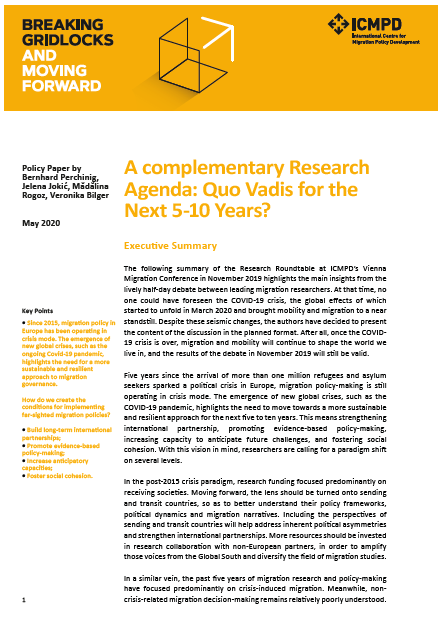
A complementary Research Agenda: Quo Vadis for the Next 5-10 Years?

Policy Brief

Published 01.05.2020

The Role of Labour Inspection in Addressing Demand in the Context of Trafficking in Human Beings for Labour Exploitation

Working Paper

Published 01.10.2017

Loading...