true

ICMPD Migration Outlook Mediterranean 2026

Document

Published 20.04.2026

Summary

This publication provides a regional perspective to ICMPD’s Migration Outlook 2026, delving into key current and emerging migration trends in the Mediterranean region, with a focus on countries of North Africa and the Middle East. Whilst it does not have the ambition to foretell the future or cover all relevant trends, the Mediterranean Migration Outlook aims to highlight significant scenarios to consider in 2026 based on the analysis of recent data and policy developments.

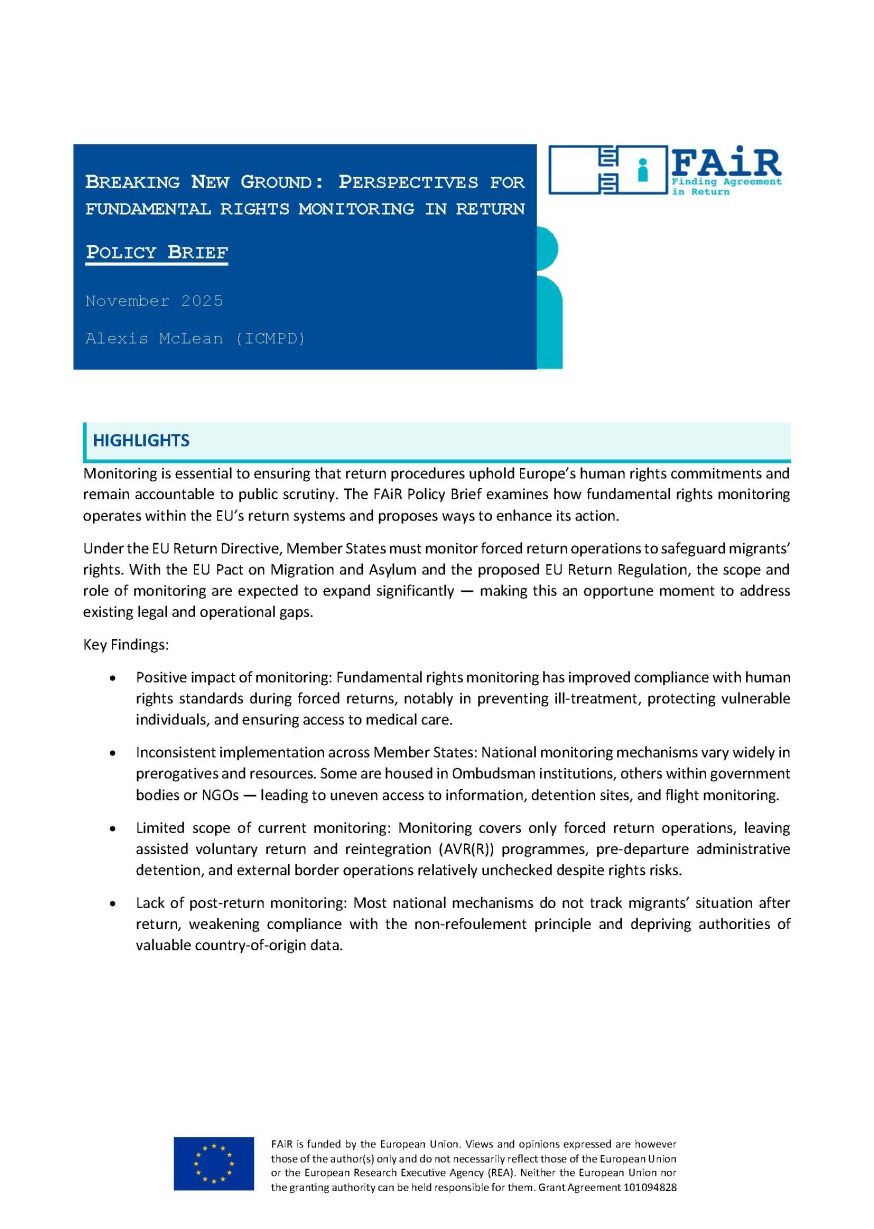
Breaking new ground: Perspectives for fundamental rights monitoring in return

Policy Brief

Published 23.04.2026

#Return, readmission and reintegration #Policy #Research

Summary

Monitoring is essential to ensuring that return procedures uphold Europe’s human rights commitments and remain accountable to public scrutiny. The FAiR Policy Brief examines how fundamental rights monitoring operates within the EU’s return systems and proposes ways to enhance its action.

Under the EU Return Directive, Member States must monitor forced return operations to safeguard migrants’ rights. With the EU Pact on Migration and Asylum and the proposed EU Return Regulation, the scope and role of monitoring are expected to expand significantly — making this an opportune moment to address existing legal and operational gaps.

Key Findings:

  • Positive impact of monitoring: Fundamental rights monitoring has improved compliance with human rights standards during forced returns, notably in preventing ill-treatment, protecting vulnerable individuals, and ensuring access to medical care.
     
  • Inconsistent implementation across Member States: National monitoring mechanisms vary widely in prerogatives and resources. Some are housed in Ombudsman institutions, others within government bodies or NGOs — leading to uneven access to information, detention sites, and flight monitoring.
     
  • Limited scope of current monitoring: Monitoring covers only forced return operations, leaving assisted voluntary return and reintegration (AVR(R)) programmes, pre-departure administrative detention, and external border operations relatively unchecked despite rights risks.
     
  • Lack of post-return monitoring: Most national mechanisms do not track migrants’ situation after return, weakening compliance with the non-refoulement principle and depriving authorities of valuable country-of-origin data.

ICMPD Annual Report 2025

Document

Published 05.05.2026

From Click to Crime: How fake job ads fuel irregular migration and trafficking from Pakistan

Document

Published 30.04.2026

Pakistan

Summary

This report analyses the rise of online fake job advertisements in Pakistan and their links to irregular migration, migrant smuggling, and human trafficking. Conducted under the Norwegian-funded FJA-PAK project, it combines desk research and stakeholder consultations to assess the social, political, and legal context, as well as the methods used by criminal networks.


The findings show that most fake job advertisements are designed to defraud prospective migrants rather than directly facilitate smuggling or trafficking. Scammers often request small, repeated payments to avoid suspicion and prolong exploitation. While some cases are connected to more serious crimes like trafficking, these are less frequent and typically involve more complex, transnational coordination.

Digital platforms—especially social media and messaging apps—play a key role in advertising fraudulent jobs, communicating with victims, and handling international payments. However, cash remains widely used for domestic transactions. Criminal networks are generally informal and loosely organised, though trafficking groups tend to be more structured and sophisticated.

Pakistan has recently strengthened its legal and policy frameworks, including reforms targeting smuggling, trafficking, and cybercrime. Despite this progress, challenges persist. In practice, distinguishing between smuggling and trafficking remains difficult, complicating law enforcement efforts. Additionally, broadly classifying all online crime as cybercrime risks overwhelming specialised units, weakening understanding of offline links, and potentially reducing penalties.

To address these issues, the report recommends stronger inter-agency coordination through clear procedures and joint task forces, increased investment in technology and training, and improved trust and collaboration among stakeholders.

In conclusion, while Pakistan has made important strides in promoting safe migration and combating exploitation, gaps in institutional capacity and prevention remain. Addressing these weaknesses is essential to disrupt criminal networks and better protect vulnerable migrants.

MMD Grant Facility 2025 Retrospective Report

Document

Published 05.05.2026

Vienna Migration Conference Report 2025

Document

Published 12.05.2026

Summary

A decade on from the first Vienna Migration Conference (VMC), VMC2025 convened policymakers, practitioners, and experts at a moment of significant geopolitical change — and at a turning point for European migration governance, with the EU Pact on Migration and Asylum approaching its implementation deadline. This report distils the discussions across two days and 15 sessions into the key insights shaping the road ahead.

ICMPD Migration Outlook Pan-Africa 2026

Document

Published 15.04.2026

Summary

ICMPD's Pan-Africa Regional Migration Outlook identifies six key trends that are expected to shape migration dynamics and policy discourse across Sub-Saharan Africa in 2026. These trends reflect structural drivers, evolving governance responses and shifting geopolitical contexts that are likely to influence both mobility patterns and the broader narrative surrounding migration in the year ahead.


This publication includes an update of the data following its release to reflect the latest available information.

Enhancing anti-trafficking prevention through targeted, participatory, and multilevel actions

Document

Published 22.05.2026

Summary

This publication draws on evolving trafficking trends across the Prague Process region and highlights evidence-based, victim-centred prevention approaches. It outlines practical measures to prevent exploitation, disrupt trafficking, and reduce risks of re-trafficking through long-term protection and reintegration, while promoting cross-sectoral responses integrated into migration, labour, social, and development policies.

Loading...