true

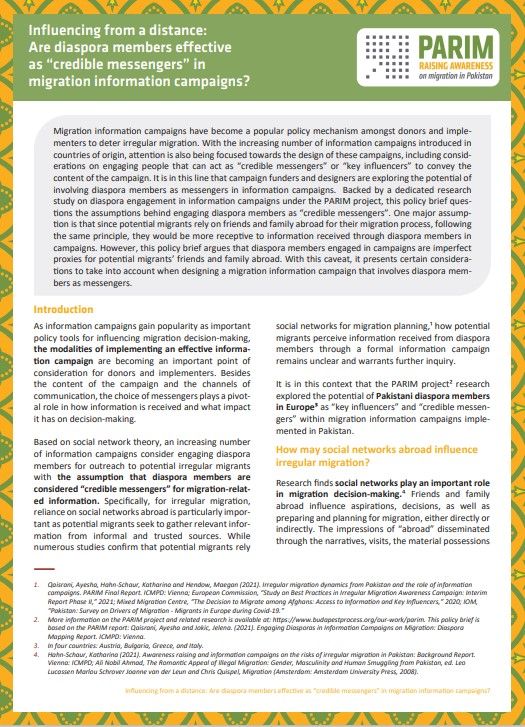
Influencing from a distance: Are diaspora members effective as “credible messengers” in migration information campaigns?

Policy Brief

Published 12.05.2022

Summary

Migration information campaigns have become a popular policy mechanism amongst donors and implementers to deter irregular migration. With the increasing number of information campaigns introduced in countries of origin, attention is also being focused towards the design of these campaigns, including considerations on engaging people that can act as “credible messengers” or “key influencers” to convey the content of the campaign. It is in this line that campaign funders and designers are exploring the potential of involving diaspora members as messengers in information campaigns. Backed by a dedicated research study on diaspora engagement in information campaigns under the PARIM project, this policy brief questions the assumptions behind engaging diaspora members as “credible messengers”. One major assumption is that since potential migrants rely on friends and family abroad for their migration process, following the same principle, they would be more receptive to information received through diaspora members in campaigns. However, this policy brief argues that diaspora members engaged in campaigns are imperfect proxies for potential migrants’ friends and family abroad. With this caveat, it presents certain considerations to take into account when designing a migration information campaign that involves diaspora members as messengers.

Youth and Mobility in the Maghreb: An Assessment of Youth Aspirations in Algeria, Libya, Morocco and Tunisia

Study

Published 10.05.2022

Summary

This study examines expert knowledge and survey data on youth aspirations in Algeria, Libya, Morocco, and Tunisia to see how the EU's Talent Partnerships might be used to increase youth employment and mobility within and from these countries.


External authors

Algeria: Yasmine Musette

Libya: Mustapha Kaaniche

Morocco: Hajar El Moukhi

Tunisia: Wajih Khallouli

ICMPD Annual Report 2021

Document

Published 09.05.2022

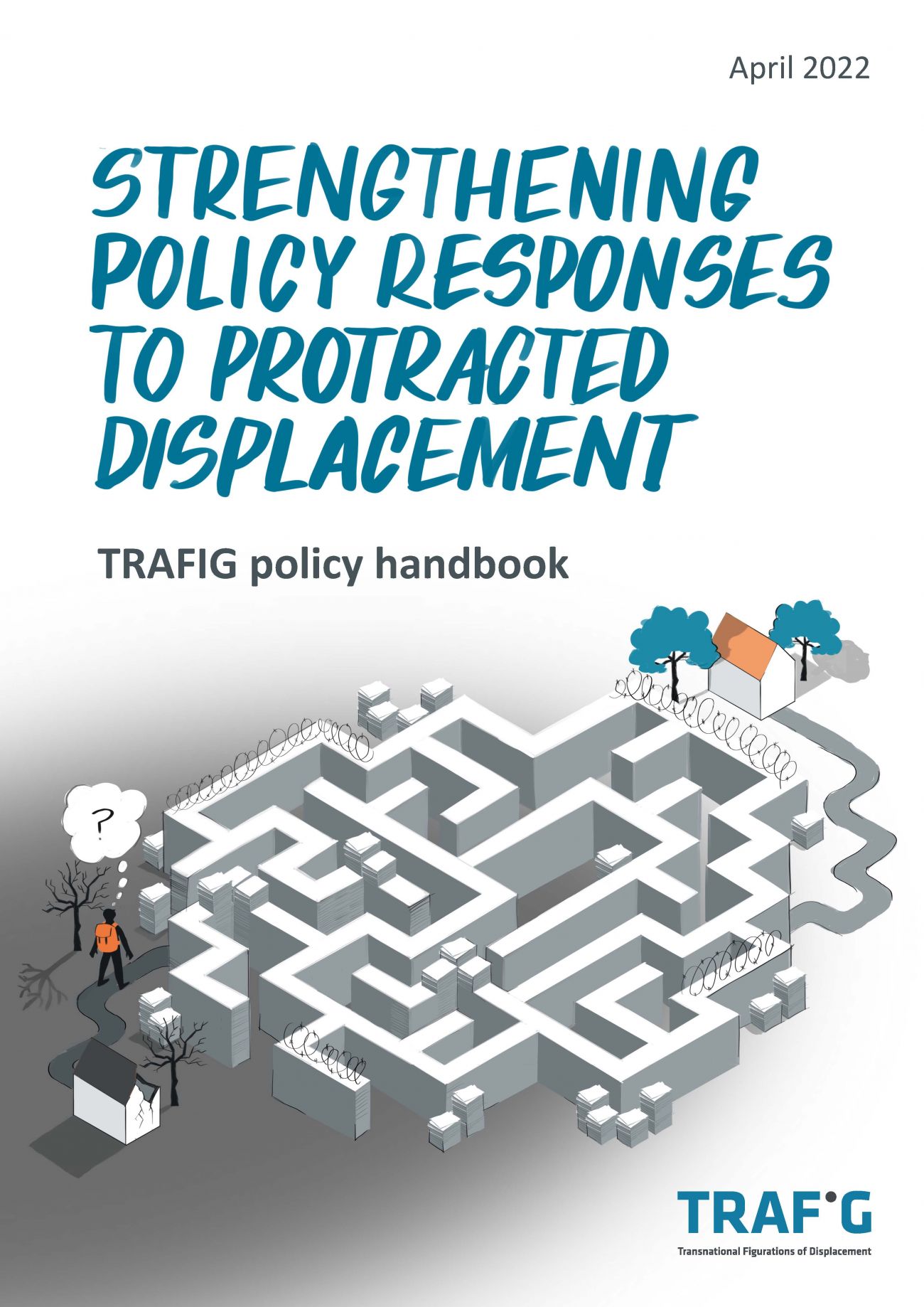
TRAFIG Policy Handbook Strengthening policy responses to protracted displacement

Study

Published 04.05.2022

Summary

Displacement is undoubtedly one of the greatest challenges facing the world today. At the end of 2020, more than 82 million people across the globe were categorised as forcibly displaced, whether remaining within their countries of origin or having crossed an international border. If this group were a country, it would rank 20th in the world in terms of population, right after Germany. An increasing number of refugees – 16 million in 2020, or 4 million more than in 2016 – find themselves in a long-term situation of vulnerability, dependency, and legal insecurity, lacking, or actively denied, opportunities to rebuild their lives. Such situations are termed ‘protracted displacement’. While not captured in these statistics, internally displaced persons (IDPs) may also find themselves in situations of protracted displacement. While the protracted nature of many conflicts is a critical contributing factor, there is considerable room for improvement in policies and practices to more effectively address protracted displacement.

This is where the EU-funded Transnational Figurations of Displacement (TRAFIG) research project has aimed to contribute. Undertaking more than 2,700 interviews with displaced persons, policymakers, and practitioners in 11 countries across the Middle East, East Africa, and Europe, the TRAFIG project investigated the reasons why people end up in protracted displacement situations and what coping strategies they use, thus identifying possible courses of action for policymakers.

This handbook shares 10 takeaways for strengthening policy responses to protracted displacement that have emerged from this endeavour, with empirical examples and policy recommendations, as well as a non-exhaustive list of promising practices for inspiration. These 10 points centre on the TRAFIG project goal of identifying solutions that are better tailored to the needs and capacities of displaced persons.
MC2CM City Migration Profile of Sfax

Document

Published 01.05.2022

Tunisia

Summary

Pôle économique et universitaire, le gouvernorat de Sfax attire plus qu’il ne produit de migrants. Le gouvernorat et la ville de Sfax font face à cinq types de flux migratoires, à savoir la migration interne, la migration en provenance de Libye, les étudiants étrangers, la migration irrégulière et les demandeurs d’asile. La situation migratoire s’est transformée depuis 2011 : la chute du régime de Kadafi en Libye a signifié une arrivée massive en Tunisie de libyens mais aussi de migrants subsahariens résidents en Libye. Aujourd’hui, la Tunisie confirme son statut de pays de transit de la migration.

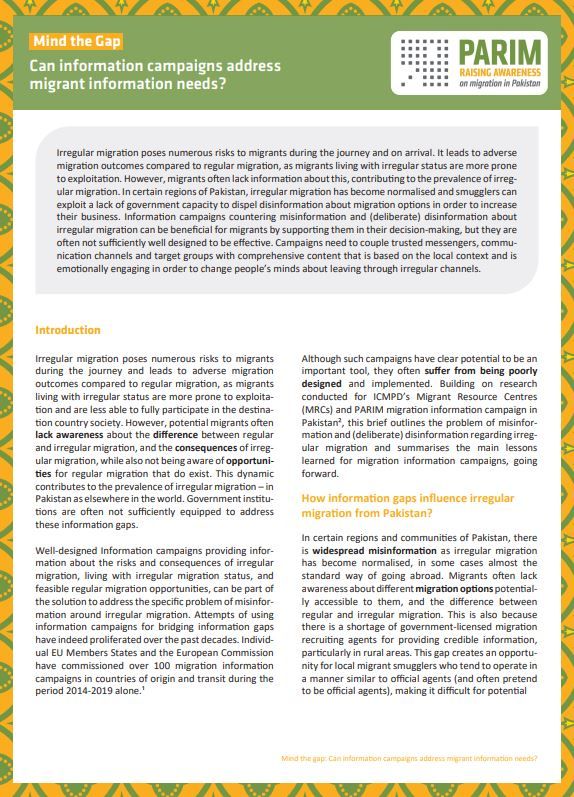
Mind the gap. Can information campaigns address migrant information needs?

Policy Brief

Published 12.04.2022

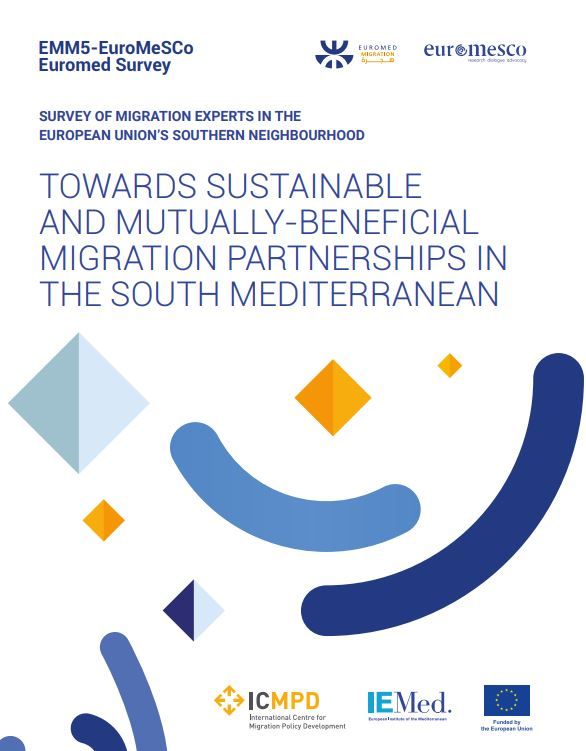
Towards sustainable and mutually-beneficial Migration Partnerships in the South Mediterranean

Study

Published 12.04.2022

Summary

Ran jointly under the EUROMED Migration V (EMM5) and “EuroMeSco: Connecting the Dots” projects, the survey “Towards sustainable and mutually beneficial migration partnerships in the South Mediterranean” aims at reflecting on migration partnerships between the EU and Southern Mediterranean countries. This report analyses the main results from this exercise, which was conducted amongst experts on migration from the EU’s South Partner Countries (SPCs) in June and July 2021. It provides new evidence on each country’s understanding on how migration partnerships should be achieved in view to advance cooperation for the benefit of migrants and all communities involved in the process.

Authors: Jenny Gilbert und Alexis Mclean

Diaspora Legislation and Engagement Policies in Lebanon, India, Ireland and Italy: A Case Study Report exploring best practices and challenges in D...

Study

Published 11.04.2022

Gender Equity Plan ICMPD 2022

Document

Published 11.04.2022

Vienna Migration Conference Report 2021

Published 11.04.2022

#Migration good governance #Policy #Cross Cutting Topics #Dialogues #Migration narratives and public opinion #Migration and development

Summary

The sixth edition of the Vienna Migration Conference (VMC) took place on 19-20 October 2021. It provided an indispensable opportunity for thought leaders, decision-makers and practitioners in the migration sphere to convene, connect and engage in strategic discussions on migration.

How did media in the Southern Mediterranean countries cover migration in 2019-2020?

Study

Published 01.04.2022

MC2CM City Migration Profile of Dortmund

Document

Published 01.04.2022

Germany

Summary

Among the OECD, Germany has become one of the main migrant-receiving nations. According to statistical data, 20.8 million of Germany’s population of 82 million are statistically recognised as migrants. Statistically the migrant population is divided almost equally between foreigners (Ausländer, 9.9 million), who do not hold German citizenship and those with a so-called migration background (Migrationshintergrund, 10.9 million) (Statistisches Bundesamt 2019). Among the group of foreigners, about half are citizens of another EU country (EU-28). Still, the Turkish constitute the largest nationality among the group of foreigners (1.5 million) (Statistisches Bundesamt 2019). Migration to Germany has a relatively long history. Migrants in Germany are thus a diverse group, reflecting different phases of migration since the post-war period. This publication provides an overview of the main phases and groups.

MC2CM City Migration Profile of Grenoble

Document

Published 01.04.2022

France

Summary

The city of Grenoble has experienced many arrivals of migrant populations during the 20th century (coming in particular from Italy, due to the proximity of the Franco-Italian border, but also from Armenia, Algeria and more generally from the Maghreb, Chile, etc.) and has developed a strong tradition of hospitality and solidarity as well as an excellent community dynamic. At the end of 2015, the city of Grenoble reaffirmed this tradition of hospitality and set up a mission "Grenoble Terre d’acceuil” (“Grenoble where welcome is assured”), supported by the elected representatives of the municipality and led by the Directorate of International and European Action. "Grenoble Terre d’accueil" has led to an integrated and unconditional approach, making the reception and inclusion of migrants residing within the city, whatever their administrative status, a mission shared amongst each of the municipality's departments. The aim is to take into account migrants residing within the city through all the undertakings it supports and to foster partnerships with the various actors within the region in order to strengthen local action.

MC2CM City Migration Profile of Seville

Document

Published 01.04.2022

Spain

Summary

The framework for local policies and integration initiatives is provided by the 2030 Agenda and the Sustainable Development Goals.In this regard, the City Council approved its 2030 Strategic Plan, the central objective of which is a shared city that advocates for more inter-related, better connected contexts, with an awareness of its advantages and opportunities.In addition, the central focus of the Strategic Plan relates to equity and participation.The migrant issue is dealt with in the Strategic Plan specifically in Strategy 5.1 on the promotion of the role of the tertiary sector and partnering with a view to providing aid, among other things, to migrants.The Plan also assumes the characteristic of inclusive multiculturalism for the city, paying specific attention to the inclusion of migrants and refugees. The migration policies of the city of Seville are implemented under principles of political and social consensus, as well as cooperation between administrations and public and private sector institutions.

People First – New Solutions to the Challenge of Displacement

Policy Brief

Published 29.03.2022

Summary

More than 82 million people – equal to the population of Germany – are forcibly displaced across the globe. An increasing number of refugees and internally displaced persons are living in long-term situations of vulnerability, dependency, and legal insecurity. This is despite the fact that every displaced person has the capacity and resources to build a new future in displacement, but is rarely given the chance to do so by current aid, development, and migration policies. This policy brief makes the case for a paradigm shift towards a people-centred approach to displacement policy that 1) considers the human capital and social networks of displaced people and 2) enables them to use and further develop their potential, including through mobility. As the world’s most powerful countries, the G7 are well positioned to play a game-changing role in reducing the scale of global displacement. This brief suggests ways that G7 countries can take a global leadership role in reframing the search for solutions by:

  • promoting displaced people’s professional expertise so they can make better use of their skills;
  • strengthening human capital by promoting education and apprenticeship opportunities;
  • leveraging the power of family networks so that its easier for them to support one another; and
  • scaling up support for the most vulnerable individuals.
Loading...